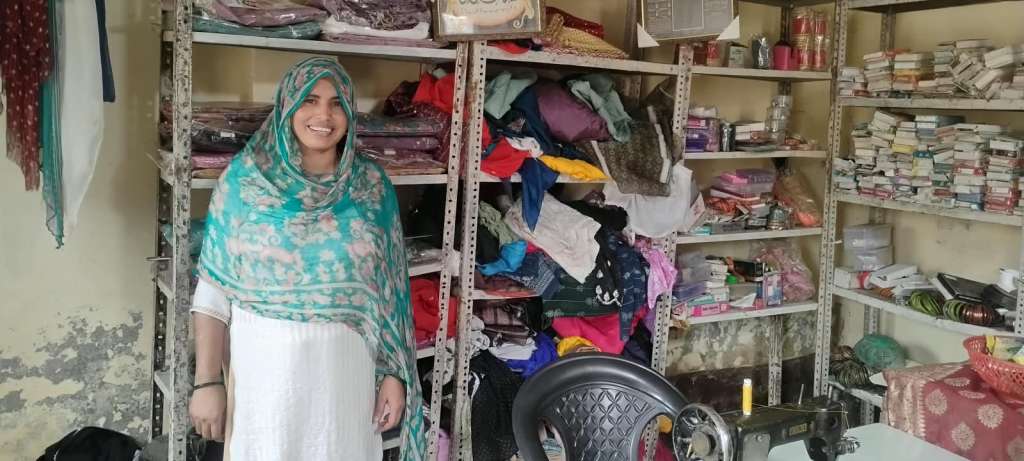
Raveena Stitches Together a New Life
“Before joining the Self-Help Group, I was confined to my home, with very little knowledge of the world outside it. Today, I run my own shop, contribute to my family’s income, and work every day to grow further,” says Raveena.
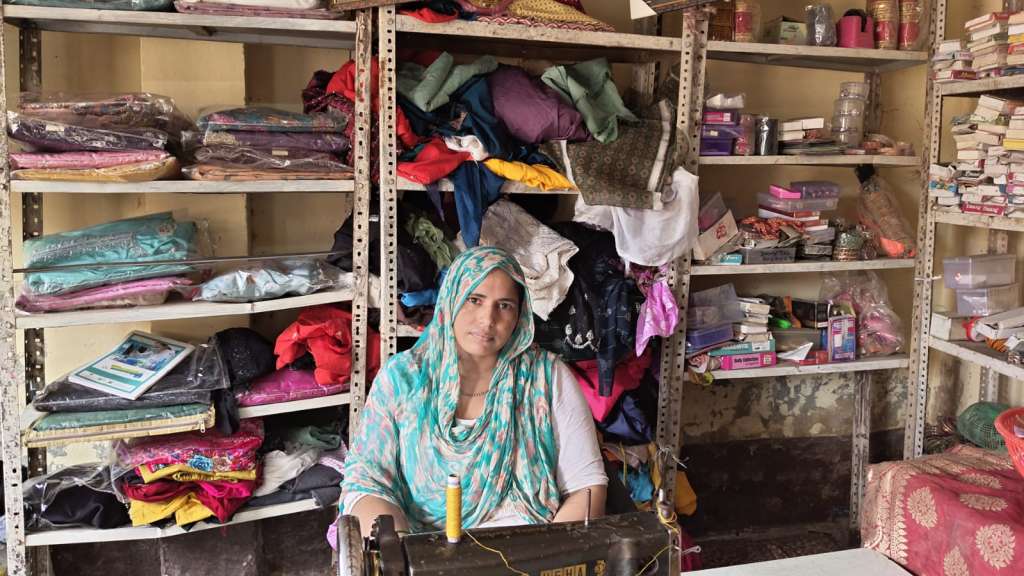
Raveena’s story shows what becomes possible when women are given not charity, but the tools of empowerment and self-reliance. A resident of Ahar village in Anupshahr block, Bulandshahr, Raveena lived a life bound almost entirely to her household. Her husband worked as a daily-wage labourer, and with four sons to raise on a limited, uncertain income, where meeting even basic household needs was a daily struggle.
Financial hardship had interrupted Raveena’s education at an early age. She studied only until Class 5 before she got married. Like many rural women from economically disadvantaged backgrounds, her world gradually became defined by household responsibilities, family expectations, and the belief that her role began and ended within the home.
Money was not the only thing that held Raveena back. She had little to no awareness of opportunities that existed beyond her home. Rigid societal norms and family expectations limited her mobility and opportunities even as she wanted to do a lot more. A lack of formal education compounded the distance between where she was and where she might have gone.
That distance began to close in 2023, when Pardada Pardadi formed a Self-Help Group in her village. Raveena joined the ‘Shahi’ Self-Help Group, which gave her something more valuable than financial assistance. It gave her knowledge, confidence, a platform, and the belief that she could shape her own future.
Through the group, she received structured exposure to savings, credit, banking, financial planning, and collective decision-making. For the first time, she began to understand that even small savings could become a foundation for something bigger, and that collective strength could create opportunities that were impossible to pursue alone.
The training did more than teach her new skills. It gave her the confidence to imagine a different life. Raveena began discussing the idea of starting her own business with her family, and with the group’s support, secured a ₹50,000 loan. With it, she opened a garment shop.
She ran it with steady discipline. Her customer base grew, and so did her income, eventually bringing in close to ₹9,000 a month for her family. It was a critical addition to a household that had long operated on the edge. Rather than stop there, Raveena added another income source by taking up tailoring alongside the shop. Between the two, her family’s annual income now stands at approximately ₹1,68,000.
Raveena no longer waits for an opportunity to come to her. Instead, she has stitched it herself, one loan repayment and one satisfied customer at a time.
Her journey from a woman with no independent income to one running two businesses reflects exactly what Pardada Pardadi’s community interventions are designed to do: replace isolation with information, and dependence with capability.
Her story proves that when rural women get the right guidance, access, and support, they don’t just improve their families’ circumstances; they even redefine their own place.